
If your jaw hurts, it makes sense to want a name for it. Most people search TMJ because that is the term they have heard. Then they read about muscles, discs, and joints, and they end up with more questions than answers.
Here is a simpler way to sort it out. Jaw pain usually traces back to one of three places: the muscles that move your jaw, the joint itself, or tension patterns in the upper neck that pull on both. Most people we see have some mix of all three.
What people mean when they say "muscular TMJ"
TMJ stands for temporomandibular joint. That is the actual hinge you can feel just in front of your ear when you open and close your mouth.
When people say muscular TMJ, they usually mean jaw pain that feels like a tired, sore, overworked muscle rather than something happening inside the hinge. The muscles doing that work are your masseter, along the side of your jaw, and your temporalis, which fans out across your temple. Both of them clench when you are stressed, concentrating, sleeping poorly, or breathing through your mouth.
The term is not wrong. It just describes where the symptom is loudest, and that is only part of the picture.
How muscle-driven jaw pain usually shows up
People with mostly muscular jaw pain tend to describe some version of this:
- A dull, tired ache along the sides of the face or in the temples
- Soreness that shows up in the morning, or builds through the afternoon
- Tenderness when they press on the cheek or temple with a fingertip
- Jaw fatigue partway through a meal, especially with chewy food
- Headaches that sit at the temples and feel like pressure
- Symptoms on both sides, even if one side is worse
Muscular pain also moves around. Some days it is the temple. Some weeks it quiets down completely, then returns during a stressful stretch at work or after a run of bad sleep.
How joint-driven jaw pain usually shows up
Joint-related symptoms tend to be more mechanical and more specific:
- Clicking, popping, or a grinding sound when opening or closing
- Pain at one exact point, right at the hinge in front of the ear
- The jaw catching, sticking, or briefly locking
- The jaw drifting to one side as it opens
- Pain that happens at a specific point in the opening range, not the whole way through
- Symptoms concentrated on one side
Joint symptoms are often more consistent day to day than muscle symptoms. If your jaw clicks at the same spot every single time you yawn, that is mechanical information worth paying attention to.
Why most people have both
The muscles and the joint are part of the same system, so they respond to each other.
When a joint is irritated, the surrounding muscles tighten up to limit how far it travels. That guarding protects the joint in the short term and makes the muscles sore over time. Going the other direction, muscles that clench for hours compress the joint and load it in a way it was not built to handle all day.
That is why sorting your symptoms into one bucket rarely works, and why two people with the same clicking can have very different reasons behind it.
When jaw pain actually starts in the neck
This is the part most people have never had explained to them.
The nerves that carry sensation from your jaw and face share pathways with the nerves from the top of your neck. Tension in the small muscles at the base of the skull can register as jaw pain, ear pressure, or a headache that wraps around the temple, even when the jaw itself is doing fine.
The neck connection tends to show up when:
- Jaw symptoms flare after long stretches at a screen, driving, or looking down at a phone
- Headaches start at the base of the skull and travel forward
- Neck tightness and jaw tightness show up together, in the same week, for the same reasons
- Symptoms switch sides
- Sleep position clearly changes how the jaw feels the next morning
Breathing matters here too. People who breathe through their mouth at night hold the jaw and tongue in a different resting position for eight hours, and the neck compensates for it.
What a night guard tells you
A night guard protects your teeth from wear, and that is a real benefit. It does not change the reason your jaw is bracing in the first place.
If you have worn one for months and you still wake up tight, still get temple headaches, or still hear clicking, that is useful information. It usually means the driver is upstream of the teeth, somewhere in the muscle, joint, and neck pattern working together.
When to get your jaw evaluated
Book an evaluation when any of these have been going on for more than a few weeks:
- Jaw tightness, clenching, or grinding that has not settled down on its own
- Clicking or popping that has started to come with pain
- Headaches you can trace to jaw or temple tension
- Neck tightness that travels with the jaw symptoms
- A guard or mouthpiece that helped partially and then stopped helping
- Jaw fatigue during meals or during conversation
Some symptoms need urgent medical care instead. Call your physician or go to urgent care if your jaw locks and will not open, if you have had a direct blow or injury to the face, or if you have swelling with a fever.
What we look at during a TMJ evaluation
We look at the jaw as part of the whole system, so the evaluation covers more than the joint.
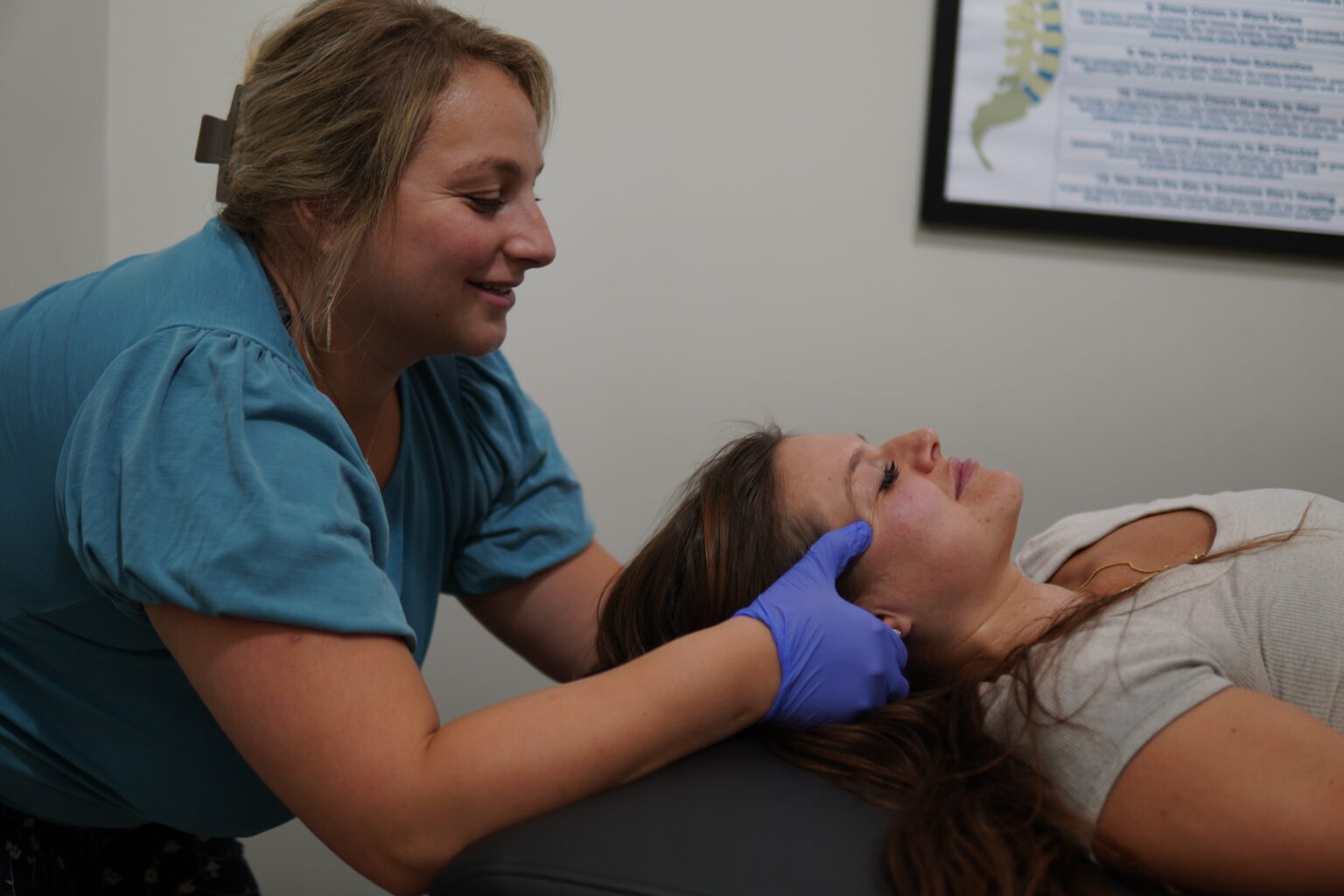
We check how the jaw opens, closes, and tracks. We check the muscles that move it and where they are holding tension. We check upper neck motion and the tension patterns in the base of the skull. We look at breathing and resting tongue position, because both change how the jaw sits all day and all night. Our doctors are craniopathy-trained, so cranial tension patterns are part of the exam rather than an afterthought.
You leave with a clear explanation of what we found, what it likely means, and whether our care is a good fit for you. If it is not the right fit, we will tell you that and point you toward who can help.
Get a clear answer about your jaw
You do not need to figure out on your own whether this is muscle, joint, or neck. That is what the evaluation is for. Bring your questions and your history, and we will walk you through what we see and what a plan would look like.
Common questions about muscular jaw pain and TMJ
How can I tell if TMJ pain is muscular or the joint?
Muscle pain is usually a dull, spreading ache in the cheek or temple that is sore to press and worse after clenching or a long day. Joint pain sits right in front of the ear and often comes with clicking, popping, catching or a jaw that will not open all the way. TMJ is the joint itself, people use the word for both, and most people have some of each at the same time. Our exam sorts it out: we check how your jaw opens, closes and tracks, press on the chewing muscles and the joint, take motion X-rays of the upper neck, and use surface EMG and thermography to see how hard those muscles work at rest. Care is gentle adjustments to the cranial bones, the jaw and the upper neck, aimed at whichever part is driving your pain.
Can jaw pain really come from my neck?
Yes, and it is more common than most people expect. The nerves carrying sensation from the upper neck share pathways with the nerves from the jaw and face. Tension at the base of the skull can register as jaw pain, ear pressure, or a temple headache. That is one reason jaw symptoms often flare after long stretches at a screen or in the car.
Why does my night guard protect my teeth but not help my jaw pain?
A night guard puts a barrier between your teeth so grinding does not wear them down. It does not change the reason your jaw is clenching. If you are still waking up tight or still getting headaches while wearing one, the driver is usually somewhere in the muscle, joint, and neck pattern rather than in the teeth themselves.
Does jaw clicking always mean something is wrong?
No. Plenty of people have a jaw that clicks and never has pain. Clicking becomes worth looking at when it comes with pain, when the jaw catches or locks, when it starts drifting to one side as it opens, or when the sound is new and getting louder.
How long should I wait before getting my jaw checked?
If the symptoms have been hanging around for more than a few weeks, or if they keep coming back every time you hit a stressful stretch, it is worth getting evaluated. Waiting usually means the surrounding muscles keep compensating, and those patterns get more established over time.
