
When TMJ pain shows up in adulthood, it usually shows up around a stressor. A move, a job change, a pregnancy, a year of bad sleep. Adults associate the pain with the stressor, so they assume the stress caused it. The truth is usually that the stress exposed a pattern that was already there.
The jaw is part of a system that includes the cranial bones, the upper neck, and the nervous system. That system was set up during childhood. If the setup was clean, the system can absorb stress without bracing. If the setup had structural compromises (cranial tension from birth, narrow palate from early mouth breathing, forward-head posture from years of looking at screens), the system braces under stress, and the jaw is one of the first places that bracing shows up.
By the time someone is 35 with daily jaw pain, the pattern has been compounding for decades. The good news is that the pattern is often still treatable. The better news is that catching it in childhood is far easier than reversing it as an adult.
Why most adults with TMJ never trace it back
Most adults with TMJ pain can’t tell you when it started. They remember the jaw clicking sometimes in their twenties. They remember a flare-up after a stressful year. They remember waking up sore for a long time before they did anything about it. What they almost never remember is the actual beginning.
That’s because TMJ patterns usually start much earlier than the symptoms show up. Childhood is where most of the structural setup happens. The patterns that lead to adult TMJ tend to begin in three specific phases of development, and by the time pain becomes the reason someone schedules an appointment, the underlying pattern has often been quietly there for ten or twenty years.
This post is for two groups. If you’re an adult with chronic TMJ pain trying to understand where your pattern came from, this will give you a clearer picture. If you’re a parent noticing jaw clicking, headaches, or grinding in your child, this will help you see why early intervention matters.
If you are an adult looking for relief right now, please see our full TMJ care page.
Three childhood patterns that lead to adult TMJ
Birth-pattern cranial tension (infancy)
Birth puts significant force through the cranial bones, the upper neck, and the jaw. Long labors, fast labors, vacuum or forceps deliveries, and C-sections all leave cranial-spinal tension patterns in different ways. The cranial bones don’t fully unwind on their own, and the patterns that get set up in infancy often stay there for life if nothing addresses them, which is where approaches like cranial chiropractic can be relevant.
These patterns show up early. Babies with birth tension often have feeding issues, head turning preference, flat spots, or arching during feeds. One pattern we see often: a baby has subtle jaw deviation or a sensitive gag reflex from cranial-spinal tension, and feeding becomes harder than it should be. The baby learns to compensate. They feed at an angle, they avoid certain textures later, they hold tension in the jaw to stabilize what isn’t stabilizing on its own. That compensation pattern doesn’t go away when the feeding issues resolve. It gets buried, and the jaw keeps doing the same compensatory work for years. By the time that child is 8 or 10, the bruxism, clenching, and jaw bracing we’re seeing are the long-tail of a feeding pattern nobody connected back to the original cause.
As the child grows, the early signs get buried under normal development, but the underlying asymmetry stays. The jaw, which sits on top of all of this, ends up working from a slightly off baseline. That’s the seed pattern for adult TMJ.
Mouth breathing and airway development (toddler through school age)
When a child breathes through their mouth instead of their nose, the tongue drops to the floor of the mouth instead of resting on the palate. The palate doesn’t widen the way it should. The upper jaw doesn’t come forward. The face grows long and narrow instead of full and open , which is a key part of mouth breathing and facial development.
This affects the jaw directly. A narrow upper jaw means the lower jaw is set back relative to where it should be. The temporomandibular joint develops with that compromised relationship as its baseline. By the time the adult teeth are in and growth slows down, the jaw is working from a position it was never supposed to be in. Clicking, deviation, and tension during the day are common downstream effects.
Many of the adults we see with TMJ symptoms had childhood histories of allergies, chronic congestion, snoring, or mouth breathing that went unaddressed. That’s not a coincidence.
Posture, screens, and bite changes (school age through adolescence)
The school years stack a different set of inputs onto whatever was already there. Hours per day of looking down at phones and tablets shift the head forward over the shoulders. The upper neck has to work harder to hold the head up. The jaw muscles end up bracing as part of that pattern. Add in orthodontic work, retainers, mouthguards, and the bite changes that happen through the teen years, and the system is being asked to adapt to a lot at once.
For kids whose foundation was clean, the system handles all of this. For kids who started with birth-pattern tension or airway compromise, the school-age years are when the pattern moves from invisible to symptomatic. Headaches start showing up. Jaw clicking becomes more noticeable. Grinding at night begins. These are early TMJ symptoms, and they’re often dismissed as growing pains.
Early signs in children that are often overlooked
Here are the signs we see most often in kids who are heading toward adult TMJ if nothing changes:
- Jaw clicking or popping when chewing or yawning
- Grinding teeth at night (parents usually hear it)
- Frequent headaches, especially after school or before bed
- Holding tension in the jaw when concentrating
- Complaining that the jaw “feels weird” or gets tired
- Chewing on one side only
- Tongue thrust (the tongue pushes forward when swallowing)
- Mouth open at rest, snoring, or restless sleep
- Forward head posture
- A history of feeding issues as an infant
- A history of texture aversion, picky eating, or strong gag reflex when introducing solids
- Bruxism or jaw clenching that started years after the original feeding pattern resolved (the connection is rarely made but it’s often there)
One or two of these on their own may not mean much. Three or more in the same kid usually means a pattern is forming that’s worth evaluating.
Why catching this early is easier than reversing it later
Bone is much more responsive to influence in childhood. The cranial bones are still fusing. The palate can still widen. The jaw is still finding its position. Posture habits are still forming. Soft tissue patterns haven’t been holding the same way for ten years yet.
In an adult, you’re working against patterns that have been in place for decades. The cranial bones have fused. The palate is set. The jaw position is what it is. You can absolutely make meaningful progress with adult TMJ care, and we do every day. But the leverage point in childhood is much higher.
A 7-year-old with early TMJ patterns and mouth breathing can often have the trajectory changed with a combination of cranial work, airway evaluation, and habit retraining. A 37-year-old with the same underlying pattern can get significant relief, but the structural foundation isn’t going to fundamentally change.
What evaluation looks like for kids
An evaluation for a child with potential early TMJ patterns starts with the history. We want to know about the birth, feeding as an infant, sleep, breathing, posture, what the parents are noticing, and what other providers have said , which is a core part of pediatric chiropractic care.
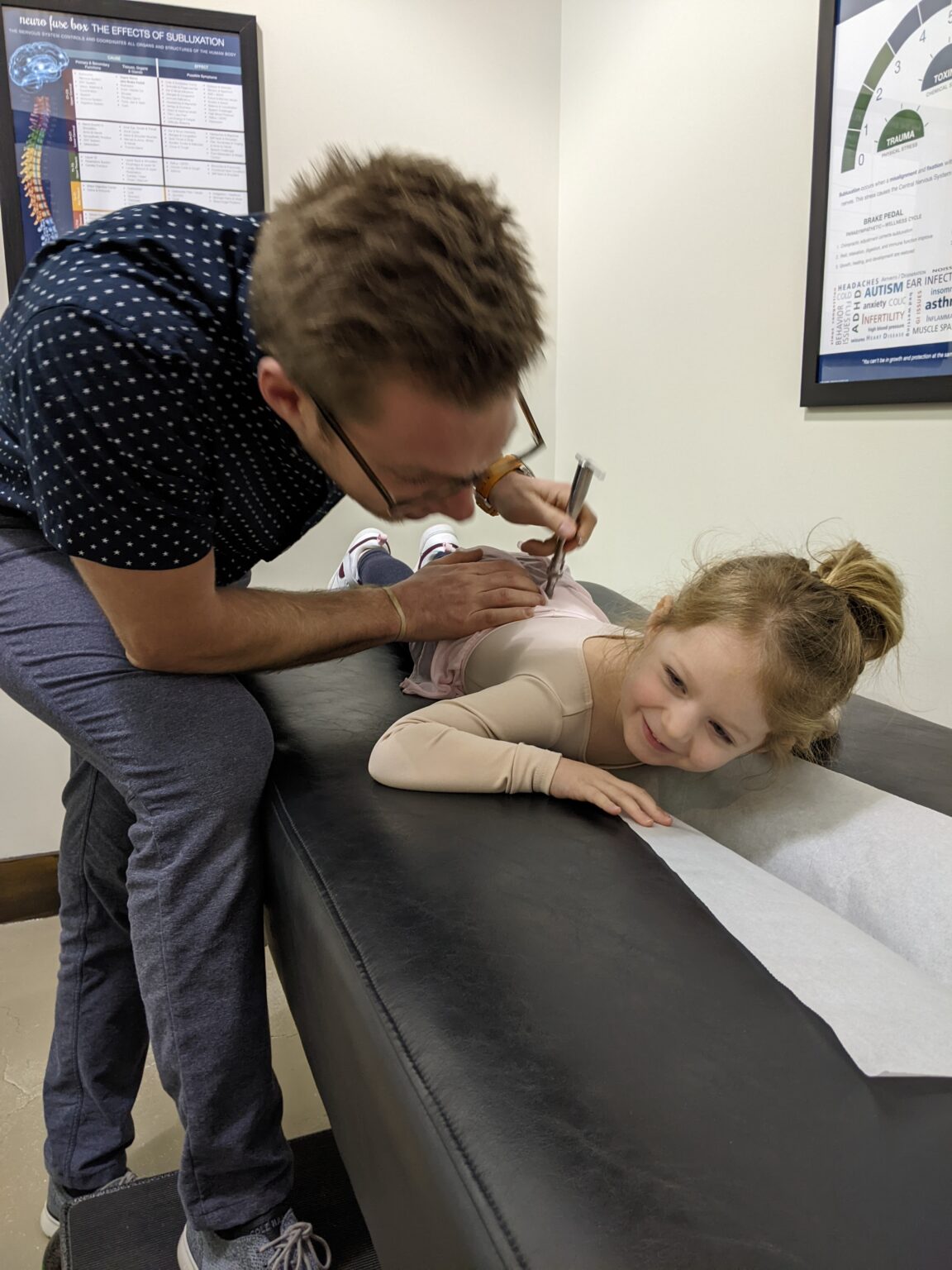
The exam is hands-on and gentle. We assess how the cranial bones are sitting, especially around the jaw and palate. We check the upper neck, jaw motion, tongue posture, and the nervous system patterns we’d expect to see if a tension pattern is present. We’re looking for the structural setup that predicts later TMJ, not just the symptoms.
We explain what we find in plain language, with the parents in the room. You’ll know what’s there, what we’d recommend, what’s in our scope, and what might need a dentist, ENT, or myofunctional therapist alongside our work.
When to seek help
If you’re an adult with TMJ symptoms, you don’t need to know exactly where your pattern started before you do something about it. Adult TMJ is treatable and we work with adult cases every day through TMJ care for adults. Knowing the childhood roots helps you understand the pattern, but the path forward is the evaluation and the care, not the archaeology.
If you’re a parent and you’re seeing early signs in your child, the time to evaluate is now, not when the pain becomes daily. Most kids we see for early TMJ patterns aren’t in pain yet. They’re showing the structural and behavioral signs that would predict pain in adulthood. Catching it at this stage is the highest-leverage moment.
The cost of evaluating early is one visit. The cost of waiting is twenty years of compounding pattern.
Common Questions About Pediatric TMJ
At what age can kids have TMJ?
What does pediatric TMJ feel like?
Will my child grow out of it?
Can a chiropractor help a child with jaw clicking?
Yes, when the chiropractor is trained in cranial and TMJ work. We’re not adjusting the jaw the way an adult chiropractor might adjust the spine. The work in kids is specific, light, and focused on the cranial bones, the upper neck, and the structural relationships that drive jaw function. Most kids find it relaxing. Many fall asleep during the visit. It’s one of the gentlest things we do.
