
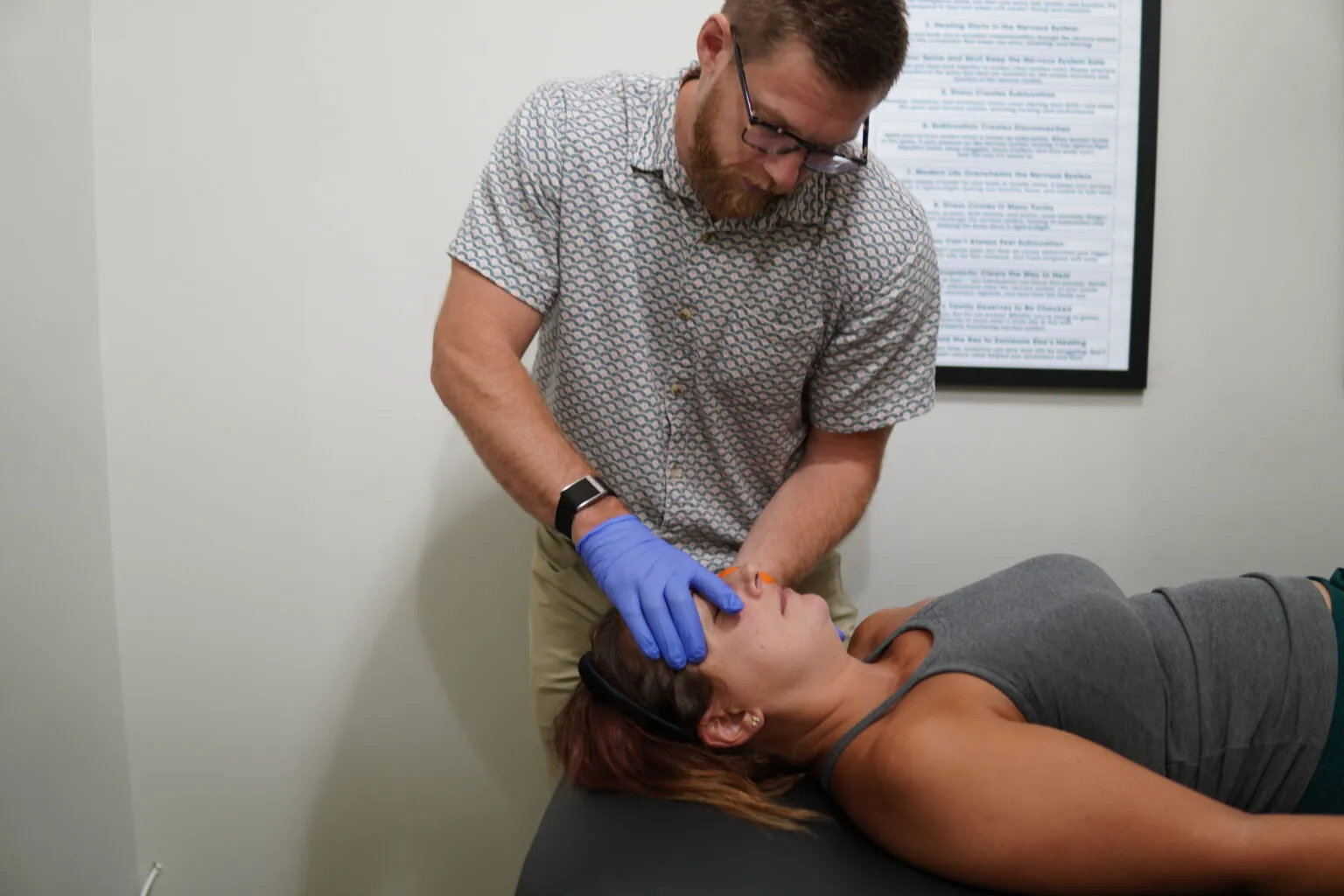
Gentle, specific cranial work for adults dealing with jaw tension and head pressure, and for babies with cranial asymmetry, airway, or feeding concerns.
What a cranial chiropractor actually does
A cranial chiropractor looks at how the bones of the skull, the upper neck, and the jaw are moving and how they are working together. The skull is not one solid piece. It is a set of bones that connect along lines called sutures, and those bones have small, specific motion. When that motion gets restricted, it can affect how the jaw closes, how the head sits on the neck, how the airway opens, and how the nervous system regulates.
Most people never hear about this part of the body because most care does not address it. Standard chiropractic focuses on the spine. Dental care focuses on the teeth and bite. Medical care usually focuses on symptoms. The cranial system sits in the middle of all of that, and when it is stuck, the patterns can show up in a lot of places that do not look connected at first.
Our job is to find where those restrictions live, explain what we are seeing in plain language, and use gentle, precise contacts to help the system move the way it is supposed to move. For adults, that often means working with the jaw and upper neck together. For babies, it means looking at head shape, palate development, and how the nervous system is regulating during feeding, sleep, and daily life.
Common patterns we see
People come to us when something has not added up. Here are the patterns we see most often.
In adults
- Jaw that clicks, pops, or shifts when closing
- Clenching or grinding, especially at night
- Facial tension, head pressure, or headaches behind the eyes or temples
- A night guard that protects the teeth but never changes the pattern
- Neck tightness that seems to travel with jaw symptoms
- History of braces, extractions, or wisdom tooth removal that changed how the bite feels
- A sense that something in the head or face is always on, even at rest
In babies and kids
- A flat spot on one side of the head, or a head shape that looks uneven
- Strong preference to turn the head one way
- Latching problems, clicking during feeds, or milk running out of the corner of the mouth
- Mouth breathing, snoring, or restless sleep
- A high or narrow palate the dentist has flagged
- Tongue tie that was released but did not fully resolve the symptoms
- Fussiness, arching, or reflux patterns that do not respond to the usual advice
Many of these patterns look unrelated from the outside. They are usually connected through the same underlying system.
How cranial work is different from standard chiropractic
Standard chiropractic care uses larger, faster adjustments to the spine. That approach has its place and works well for a lot of people. Cranial work is a different skill set.
Cranial adjustments are small and specific. The contacts are light. There is no cracking or twisting. The goal is to find the one bone, suture, or tension pattern that is driving the restriction and help it release without forcing anything around it.
For adults, this matters because the jaw, upper neck, and cranial bones share the same nervous system and the same protective reflexes. Adjusting the neck without addressing the jaw, or adjusting the jaw without addressing the cranial tension around it, often leaves the pattern in place. The symptoms come back.
For babies, it matters even more. An infant skull is soft, flexible, and still developing. The work has to be gentle enough that the baby stays calm, and precise enough that the restrictions actually release. Most babies relax during the visit. Many fall asleep.
We use cranial techniques alongside neurologically based chiropractic so the whole system gets addressed in one plan, not in pieces across different offices.
What an evaluation looks like
An evaluation shows us what is driving what you are dealing with and how cranial care can help. Here is what that actually looks like.
Step 1: The conversation
We start by listening. What is going on, how long has it been going on, what have you already tried, and what are you hoping to figure out. For a child, this conversation happens with the parent. For an adult, it happens with you directly. No rush.
Step 2: The exam
We look at the areas that tend to drive cranial patterns:
- How the jaw opens, closes, and tracks
- Upper neck motion and tension
- Cranial bone motion and suture tension
- Palate shape and tongue posture (when relevant)
- Nervous system signs like breathing pattern, posture, and regulation
For infants, we also check head shape measurements, palate, latch quality, and any reflex patterns that give us information about how the system is organizing.
Step 3: The report
We sit down and tell you what we found in language you can actually use. What the patterns are. What we think is driving them. Whether we can help, and if so, what a care plan would look like. If part of it is outside what we do, we say that clearly and work with the provider who handles it.
Step 4: The decision
You decide what makes sense for you or your child. No pressure. No same day push. The evaluation gives you clarity. What you do with that clarity is your call.
When people usually consider cranial care
Most people who end up here have already tried a lot of things. Adults have usually seen a dentist, maybe a physical therapist, and sometimes a neurologist. They have a night guard, a stretching routine, or a prescription that helped a little. The symptoms are still there.
Parents have usually seen a pediatrician, a lactation consultant, and sometimes a specialist for head shape or feeding. They have been told to give it time, or that the baby will grow out of it. Something in their gut is telling them the pattern is not just going away on its own.
The common thread is that the people who come to us are done guessing. They are not looking for another opinion that sends them in circles. They want someone to actually look at the whole picture, connect the dots, and give them a clear path forward.
If that sounds like where you are, a cranial evaluation is the right next step.
Ready for a real look at what is going on?
A cranial evaluation gives you clarity on the patterns that have been driving your symptoms, and a clear plan for what to do next. For adults and kids.
Cranial chiropractic care: common questions
What is cranial chiropractic?
Cranial chiropractic is a gentle, specific approach that looks at how the bones of the skull, the jaw, and the upper neck are moving together. The adjustments are light and precise. The goal is to release restrictions in the cranial system so the jaw, airway, and nervous system can function the way they are supposed to.
Is cranial work safe for babies?
Yes. The work on infants is gentle enough that most babies stay calm during the visit, and many fall asleep. There is no forceful motion. We use light, specific contacts that match how a baby’s cranial system is built. Parents are with their child the entire time.
How is cranial chiropractic different from craniosacral therapy?
Craniosacral therapy is usually done by massage therapists, physical therapists, or other hands-on practitioners and focuses on light touch and fluid rhythm. Cranial chiropractic is performed by a chiropractor trained in cranial techniques, uses specific diagnostic steps, and is integrated with full nervous system and spinal assessment. The approaches can overlap in feel, but the training, scope, and framework are different.
Can cranial adjustments help with TMJ or headaches?
For many adults, yes. TMJ symptoms and head tension are often driven by a combination of jaw, upper neck, and cranial bone restrictions. Addressing all three together tends to give better, longer-lasting results than working on one area in isolation. The evaluation is how we determine whether your specific pattern fits what cranial care addresses.
How many visits until I see a difference?
It depends on the pattern, how long it has been there, and the body’s adaptability. Some adults notice shifts in jaw tension or head pressure within the first few visits. Others need a longer runway. Babies often show changes in feeding, sleep, or head shape within two to four weeks of starting care. We outline a realistic timeline at the report of findings so you know what to expect.
Start with a cranial evaluation
Wall Township, Sea Girt, and the surrounding area. For adults and kids.
