Cranial Chiropractic vs. Dental Splint for TMJ: What Each Does and Who It's For
If you’re reading this, you’ve probably already tried a night guard or a dental splint. Maybe it helped some. Maybe it protected your teeth but didn’t change the clenching. Maybe you’re still waking up with a sore jaw, headaches, or that familiar tightness around your ears.
You’re trying to figure out what to do next. A friend or your dentist may have mentioned cranial chiropractic, and now you’re wondering how the two compare.
This page is meant to give you a straight answer. Both approaches have real value. They do different things mechanically, they overlap in a few places, and the right starting point depends on what’s actually driving your symptoms.
Why people end up comparing these two approaches

Most adults with TMJ symptoms see a dentist first. That makes sense, because the jaw lives in the mouth and a night guard is one of the most common recommendations. For a lot of people, that’s enough. The grinding stops damaging the teeth, the muscles relax, and life goes on.
Then there’s another group. The guard helps a little, but the underlying tightness, clicking, or headache pattern doesn’t change. They’re still clenching during the day. The jaw still deviates when they open. They still wake up tired.
That’s usually when people start looking for a different lens. Not because the dentist did anything wrong, but because the jaw isn’t working in isolation. It’s connected to the cranial bones above it, the upper neck behind it, and the nervous system that controls the muscles around it. When those things stay tense, the jaw keeps bracing, and a guard alone can’t reach those inputs. Discover how to tell what’s driving your jaw pain.
What a dental splint does
A dental splint, also called a night guard or occlusal appliance, is a custom-made device that fits over the upper or lower teeth. It does three main things. It separates the teeth so the surfaces can’t grind against each other. It creates a controlled bite surface that distributes force more evenly across the jaw. And depending on the design, it can subtly change how the jaw rests at night, which sometimes lets the muscles unload.
The splint is most useful when the primary problem is grinding or clenching that’s wearing down the teeth. Dentists fit them for that reason, and they work well for that purpose. They protect enamel, prevent cracked teeth, and reduce some of the muscle fatigue that comes from grinding for hours every night.
Where a splint is the right tool: heavy nighttime grinding, visible tooth wear, fractured or chipped teeth from clenching, or a clear bite issue your dentist has identified. If your dentist tells you a splint is needed to protect your teeth, that’s a real reason and worth listening to.
What cranial chiropractic does for TMJ
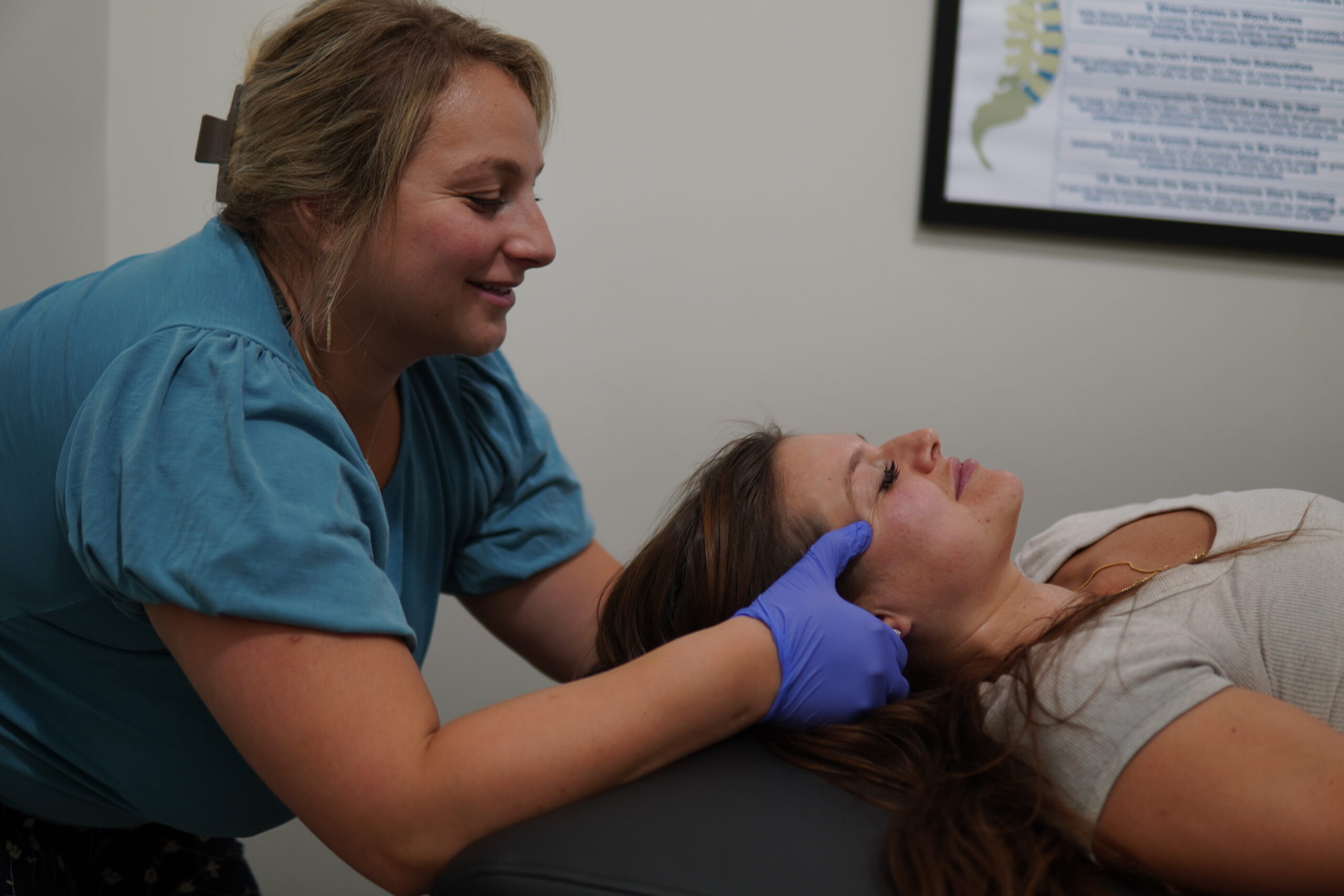
Cranial chiropractic looks at the jaw as part of a larger system. The jaw connects to the temporal bones on the sides of the head. The temporal bones connect to the rest of the cranial bones. And all of that sits on top of the upper neck, which has a direct neurological relationship to jaw muscle tone.
When we evaluate someone with TMJ symptoms, we look at how the cranial bones are sitting relative to each other, how the upper neck is moving, and how the nervous system is regulating muscle tension throughout the head, neck, and face. We use gentle, specific adjustments to release patterns of tension in the cranial bones and upper neck. Most people don’t even realize what cranial chiropractic actually is until they experience it.
The mechanism is different from a splint. A splint manages what’s happening in the mouth. Cranial chiropractic addresses why the jaw is bracing in the first place, by working on the structures and nerves that drive jaw muscle tone. For a lot of TMJ patients, that’s the missing piece.
Where they overlap and where they don't
Here’s a clear breakdown of what each approach addresses and where the gaps are.
| What it addresses | Dental splint | Cranial chiropractic |
|---|---|---|
| Tooth wear from grinding | Direct protection | No |
| Bite and tooth contact | Adjusts how teeth meet at night | No |
| Cranial bone tension and motion | No | Direct focus |
| Upper neck (C0 to C2) tension feeding the jaw | No | Direct focus |
| Nervous system tone and bracing patterns | No | Direct focus |
| Jaw muscle tension during the day | Sometimes reduces clenching cycle | Addresses through cranial and neck inputs |
| Jaw clicking and deviation | Limited effect | Direct focus |
| Headaches that travel from jaw to temples | Sometimes helps | Direct focus |

The pattern most people find: a splint protects the teeth and reduces some grinding, but it doesn’t change why the jaw is bracing. Cranial chiropractic addresses the bracing pattern but doesn’t replace tooth protection if you’re a heavy grinder.
When you might benefit from both
Some people get the best results using both approaches together. A splint protects the teeth at night while cranial chiropractic works on the underlying tension patterns during the day. As the cranial and nervous system inputs settle, the clenching often calms down, and some people eventually need the splint less. Others keep using it long-term as protection while their jaw stays calmer overall.
This is especially common for people who have heavy grinding plus daytime symptoms (headaches, neck tension, clicking, jaw fatigue). The splint handles the night damage. Cranial chiropractic handles what’s happening in the system the rest of the time.
Where they overlap and where they don't
Here’s a clear breakdown of what each approach addresses and where the gaps are.

Start with a splint when
- Your dentist has identified clear tooth wear or cracking from grinding
- Your symptoms are mostly nighttime grinding with limited daytime jaw issues
- You haven't tried tooth protection yet and your dentist recommends it

Start with cranial chiropractic when
- You've already tried a splint and it helped some, but the tightness, clicking, or headaches are still there
- Your jaw clicks, pops, or deviates when you open
- You clench during the day, not just at night
- You have headaches that travel between your jaw, temples, and upper neck
- You feel like the jaw is part of a bigger pattern of bracing or tension

Start with both when you have heavy grinding plus a daytime tension pattern, and you want to address both layers at the same time.

What our evaluation looks like
When you come in for a TMJ evaluation at Absolute, we walk you through three things. First, we listen. We want to know what your jaw is doing, what you’ve already tried, and what’s still bothering you. We’re not trying to talk you out of anything you’ve done with your dentist. We want to figure out where the gap is. Learn more on our TMJ and cranial chiropractic page.
Second, we evaluate. We look at how the cranial bones are sitting, how the upper neck is moving, and how the nervous system is regulating muscle tension in the area. This is a hands-on, doctor-level exam. It’s not generic chiropractic. It’s specific to the cranial and TMJ system.
Third, we explain what we find in plain language. You’ll know what the patterns are, what we’d recommend, and whether our approach is a good fit. If you already see a dentist or another provider, we share what we find and work alongside them.
Common Questions About TMJ Care
No. We don't tell people to stop wearing a guard their dentist prescribed. If your dentist fitted you for a splint to protect your teeth, that's still doing a job we can't do. Our work is on the cranial bones, upper neck, and nervous system inputs that drive the clenching pattern. The two approaches address different things, and they work fine alongside each other.
If at some point your dentist re-evaluates and feels the splint is no longer needed, that's a conversation between you and your dentist. We don't make that call.
No. We're not adjusting the bite or the position of the teeth. That's outside our scope and outside the scope of chiropractic in general. Cranial chiropractic works on the cranial bones (the bones of the head outside of the jaw itself), the temporomandibular joint structures, and the upper neck. Many patients tell us their bite actually feels more even after cranial work, because the surrounding tension patterns settle. But changing the actual occlusion is a dental issue, not a chiropractic one.
No referral needed. You can book a TMJ evaluation directly with us. If we see something during the exam that we think your dentist or another specialist should look at, we'll tell you and we'll communicate with them if you want us to. We work with dentists in the area regularly, and a lot of our TMJ patients are seeing both of us at the same time.
Most people start to notice changes in the first two to four weeks of care. That can look like a quieter jaw at rest, less morning soreness, fewer headaches, or a reduction in clicking. We'll do a re-exam at a set point so we can compare what's actually changed in the joint and surrounding tissue, not just how you feel.
TMJ patterns that have been there for years usually take longer to fully settle than recent ones. Either way, you should have a clear sense of whether our approach is helping within the first month.
TMJ patterns that have been there for years usually take longer to fully settle than recent ones. Either way, you should have a clear sense of whether our approach is helping within the first month.