Gentle Care for Infant Torticollis

What Torticollis Looks Like
Torticollis is the word for a head tilt that shows up in babies. Parents usually notice one or more of these patterns:
- Baby’s head tilts toward one shoulder most of the time
- Baby prefers turning their head one way and resists the other
- A flat spot forming on one side of the back of the head
- Feeding goes smoother on one side than the other
- Fussiness or frustration during tummy time
- Chin points slightly away from the tilted side
If any of these feel familiar, you are seeing something real. It is worth checking.
How Head Tilt Connects to Cranial Pattern and Feeding
In the early months, a baby’s cranial bones are soft and still fusing. The neck, jaw, and cranial bones develop together. When the head holds one position for a long time, it can influence how those bones are fusing and how the jaw and palate take shape.
That same pattern often shows up at feeding time. A baby who turns easily one way may latch well on one side and struggle on the other. Because head position, latch, and breathing are all linked, we look at the whole picture. That includes the neck, the cranial pattern, jaw and palate development, and how your baby feeds and breathes.

Our Gentle Evaluation
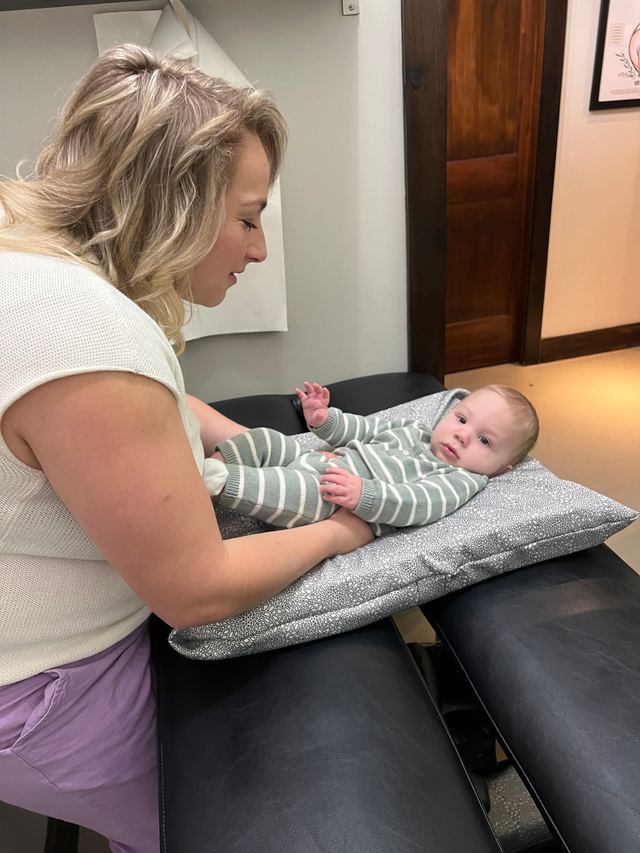
- Head and neck movement in both directions
- The cranial pattern and any flattening
- Jaw and palate development
- How your baby feeds and breathes
When to Seek Care

What to Expect

Common questions
Is chiropractic care safe for babies?
Will one visit fix my baby's head tilt?
My pediatrician mentioned torticollis. Can you still help?
How early can we come in?
Does the head tilt connect to feeding problems?
What does the evaluation actually involve?
How do I help my baby's flat head without a helmet?
Start with what takes pressure off the flat spot: plenty of supervised tummy time, switching which way your baby faces in the crib and when you hold and feed, and less time lying back in car seats, swings and bouncers. A flat spot usually comes from resting on the same side of the head, and that often happens because the neck is tight and turning the other way is uncomfortable. Our doctors look at how your baby’s head and neck move, the shape of the head, palate and jaw, tongue function, the nervous system, and how your baby is growing, and use light, gentle hands-on care to ease the tension that keeps the head turned to one side. We work alongside your pediatrician and physical therapist, and alongside a helmet team if a helmet is recommended.
Is it too late to help a flat head at 6 months?
No. The skull is still growing quickly at six months, and the neck tension that often sits behind a flat spot can be worked on at any age. Growth slows as the first year goes on, so this is a good time to have it looked at rather than wait. Our doctors check how your baby’s head and neck move, the shape of the head, palate and jaw, tongue function, the nervous system and how your baby is growing, and use light, gentle hands-on care alongside your pediatrician and any physical therapy or helmet team.
Why will my baby not turn his head to one side?
Most often because the neck muscles on one side are tight, a pattern called torticollis, which can come from how your baby was lying in the womb or from a long or hard birth. Turning toward the tight side is uncomfortable, so your baby keeps looking the other way, may feed better on one breast, and can start to flatten on one side of the head. Call your pediatrician right away if the head tilt comes with a fever, weakness or a baby who is not feeding. Our doctors look at how the neck, head and jaw move, tongue function, the nervous system and how your baby is growing, and use light, gentle hands-on care to ease the tension, sharing what we find with your pediatrician and physical therapist.